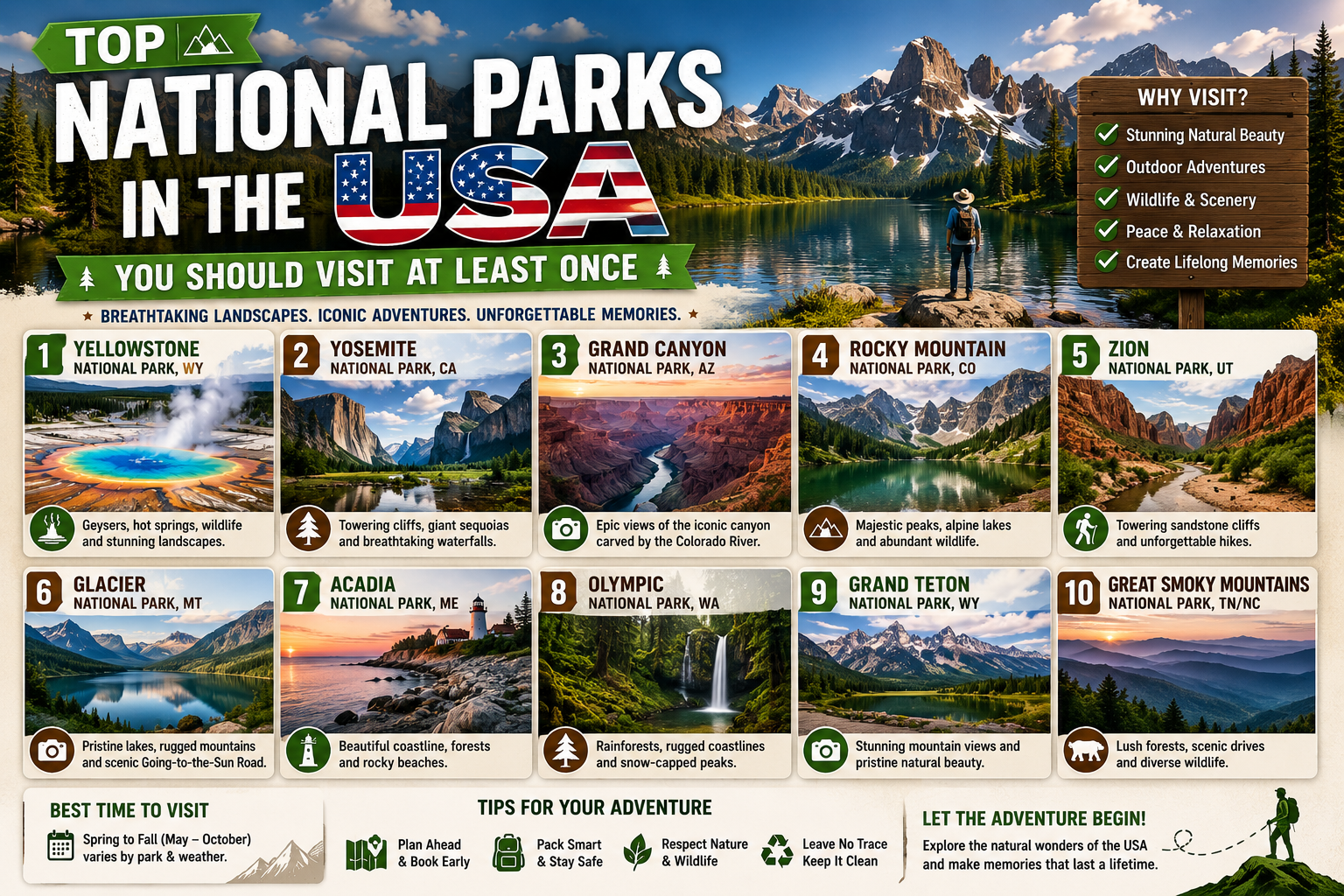
The United States is home to some of the most diverse, dramatic, and breathtaking landscapes on the planet. To protect these natural wonders, the country has set aside millions of acres of protected land under the National Park Service. top national parks in the usa. From towering granite cliffs and explosive volcanic geysers to misty mountain ridges and deep desert canyons, these spaces showcase nature at its absolute grandest.
Whether you are an avid backcountry hiker, a wildlife photographer, or a family traveler looking for a scenic road trip, visiting America’s national parks is a bucket-list experience.
If you want to experience the true, untamed beauty of the American wilderness, here are the top national parks in the USA that you must visit at least once in your lifetime.
1. Yellowstone National Park (Wyoming, Montana, Idaho)
- Best Known For: Geothermal wonders, explosive geysers, and abundant wildlife.
- Iconic Landmarks: Old Faithful, Grand Prismatic Spring, and Lamar Valley.
Established in 1872, Yellowstone holds the historic title of being the world’s very first national park. It sits directly atop a massive, active supervolcano, which fuels the park’s incredible geothermal features. Yellowstone contains roughly half of the world’s active geysers, creating a surreal landscape of bubbling mud pots, steaming hot springs, and rushing rivers.
Beyond its volcanic plumbing, Yellowstone is often called the “Serengeti of America” because of its massive concentration of free-roaming wildlife. If you drive through the Lamar or Hayden valleys at dawn, you are highly likely to spot grizzly bears, thousands of wild bison, elk, and gray wolves roaming the open plains.
2. Yosemite National Park (California)
- Best Known For: Towering granite cliffs, ancient giant sequoias, and massive waterfalls.
- Iconic Landmarks: El Capitan, Half Dome, and Yosemite Valley.
Located in California’s Sierra Nevada mountains, Yosemite National Park is an open-air temple of natural grandeur. The heart of the park is Yosemite Valley, a glacier-carved canyon lined by sheer, 3,000-foot vertical granite walls that draw rock climbers from every corner of the globe.
Visiting Yosemite in late spring is a magical experience because the melting winter snow causes the park’s legendary waterfalls—including Yosemite Falls, which drops 2,425 feet—to roar with thunderous power. Beyond the valley, you can hike through Mariposa Grove to stand in the shadow of ancient giant sequoia trees that have been growing for over 2,000 years.
3. Grand Canyon National Park (Arizona)
- Best Known For: A mile-deep gorge displaying millions of years of geological history.
- Iconic Landmarks: Mather Point, Bright Angel Trail, and the Desert View Watchtower.
The Grand Canyon is one of those rare global destinations that fully lives up to its massive reputation. Carved over millions of years by the steady flow of the Colorado River, this immense canyon stretches for 278 miles and plunges a full mile deep into the earth.
The scale of the canyon is difficult to comprehend until you stand directly on the edge of the South Rim. As the sun sets, the layers of ancient rock change colors, glowing in vibrant shades of deep orange, red, and purple. For an adventurous experience, you can hike down the Bright Angel Trail into the canyon or take a guided mule ride along the cliff edges.
4. Zion National Park (Utah)
- Best Known For: Striking red sandstone cliffs and thrilling slot canyon hikes.
- Iconic Landmarks: Angels Landing, The Narrows, and Checkerboard Mesa.
Zion National Park is a wilderness masterpiece characterized by its vertical topography. Unlike the Grand Canyon, where you look down from the rim, visiting Zion involves standing on the canyon floor and looking up at towering, brilliantly colored red and cream sandstone cliffs.
Zion is home to two of the most famous, bucket-list hikes in the entire United States:
- Angels Landing: A thrilling, narrow ridge hike with steep 1,000-foot drops on both sides, requiring hikers to hold onto metal chains anchored into the rock.
- The Narrows: A unique hike where the canyon walls shrink to just 20 feet wide and 1,000 feet tall, forcing you to wade directly through the cool waters of the Virgin River.
5. Great Smoky Mountains National Park (Tennessee & North Carolina)
- Best Known For: Misty blue ridges, historic homesteads, and rich biodiversity.
- Iconic Landmarks: Clingmans Dome, Cades Cove, and Laurel Falls.
Attracting over 11 million visitors annually, the Great Smoky Mountains proudly stand as the most visited national park in the United States. The park gets its poetic name from the natural, smoke-like blue mist that constantly hangs over its endless, rolling mountain ridges.
One of the park’s biggest draws is its incredible accessibility and the fact that it charges no entrance fee. Visitors can explore over 800 miles of hiking trails, view historic 19th-century log cabins in Cades Cove, and watch wild black bears forage in the lush valleys. It is also globally famous for its autumn foliage, when the dense forests turn into a vibrant sea of red, gold, and orange.
6. Glacier National Park (Montana)
- Best Known For: Alpine lakes, sharp mountain peaks, and historic scenic drives.
- Iconic Landmarks: Going-to-the-Sun Road, Logan Pass, and Lake McDonald.
Tucked away in the northern reaches of Montana, Glacier National Park is a paradise of pristine alpine wilderness. The park contains dozens of dramatic, glacier-carved valleys, crystal-clear turquoise lakes, and jagged peaks that form the backbone of the Northern Rocky Mountains.
The signature experience in Glacier is driving the legendary Going-to-the-Sun Road. This narrow, 50-mile engineering marvel cuts directly across the heart of the park, hugging steep cliff edges and crossing the Continental Divide at Logan Pass. It provides some of the most jaw-dropping mountain vistas accessible by a vehicle anywhere in North America.
7. Olympic National Park (Washington)
- Best Known For: Extreme ecological diversity, temperate rainforests, and rugged coastlines.
- Iconic Landmarks: Hoh Rain Forest, Ruby Beach, and Hurricane Ridge.
Olympic National Park is incredibly unique because it is essentially three entirely different parks packed into one destination. top national parks in the usa. Within a single day, you can explore the glaciated peaks of the Olympic Mountains, walk through the moss-draped canopy of the Hoh Rain Forest (the largest temperate rainforest in the country), and beachcomb along 70 miles of wild, rugged Pacific ocean coastline littered with massive sea stacks. It is an absolute must-visit for travelers who love varied, moody, and untamed coastal landscapes.
Quick Comparison Matrix for Planning Your Visit
| National Park | Primary Landscape | Best Time to Visit | Essential Experience |
| Yellowstone | Geothermal & Wildlife | June – September | Watching Old Faithful erupt |
| Yosemite | Granite Valley & Forests | May – June (for waterfalls) | Viewing El Capitan from the valley |
| Grand Canyon | Deep Desert Gorge | March – May / Sept – Nov | Catching the sunset over the rim |
| Zion | Red Sandstone Canyons | April – October | Wading through The Narrows |
| Great Smokies | Forested Mountain Ridges | October (for fall colors) | Driving through scenic Cades Cove |
| Glacier | Alpine Lakes & Peaks | July – August | Driving Going-to-the-Sun Road |
| Olympic | Rainforest & Wild Coast | June – September | Walking through the Hoh Rain Forest |
Pro Tips for an Unforgettable National Park Trip
- Buy the America the Beautiful Pass: If you plan on visiting more than two or three national parks within a year, buy the annual $80 pass. It grants unlimited entry to all federal recreation sites and saves you a significant amount of money on entrance fees.
- Check for Vehicle Reservations: Due to growing crowds, popular parks like Yosemite, Glacier, and Rocky Mountain require advanced vehicle timed-entry reservations during peak summer months. Always check the official park websites months before your trip. top national parks in the usa.
- Leave No Trace: Help keep these historic wilderness areas pristine. Pack out all your trash, never feed the local wildlife, and stay on designated hiking trails to protect the fragile local ecosystems.
Final Thoughts
America’s national parks protect the true, living soul of the country’s natural heritage. top national parks in the usa. Whether you are standing in awe before the colorful waters of Yellowstone or conquering your fears on the ridges of Zion, these landscapes offer a profound sense of discovery and connection to nature that you cannot find anywhere else. Pack your bags, lace up your hiking boots, and make plans to experience these iconic parks at least once!
Best Places to Visit in the USA in 2026: The Ultimate Travel Guide
Amtrak