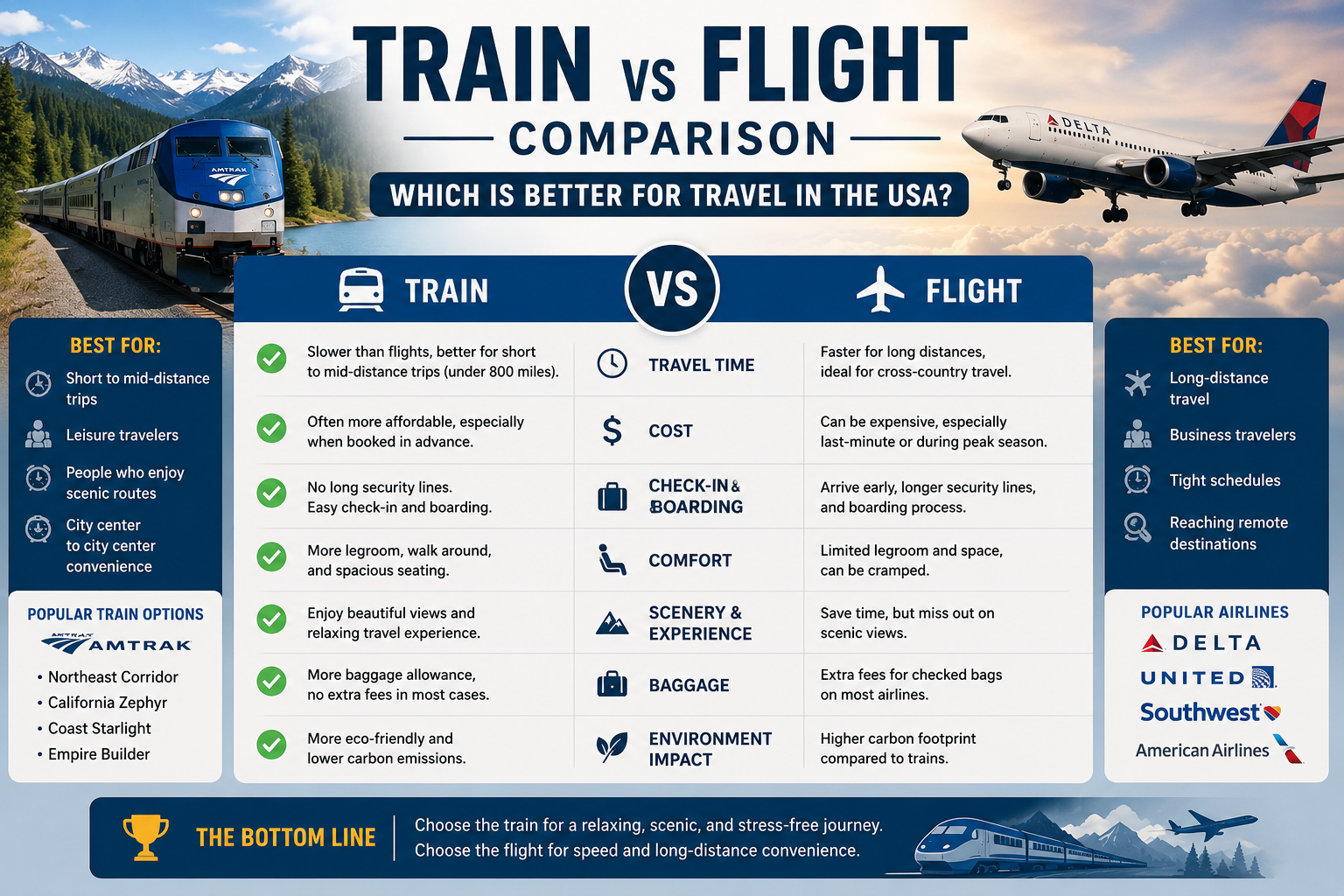
When planning a trip across the United States, one of the biggest decisions you will make is choosing how to get there. For decades, flying was the default choice for anyone looking to cross the country quickly. However, train travel—primarily through Amtrak—has seen a massive resurgence as travelers look for more relaxing, eco-friendly, and scenic alternatives.
Both options have their own distinct pros and cons. A flight gets you across the country in hours, but it comes with long security lines, hidden baggage fees, and cramped seats. Train vs. Flight comparison. A train takes much longer, but it offers massive legroom, breathtaking views, and a stress-free environment.
So, which one is truly better for your next American adventure? Let’s break down the ultimate Train vs. Flight comparison across every major category.
1. Speed and Travel Time
When it comes to pure speed, airplanes win by a landslide. However, the total travel time is not always as simple as the flight duration listed on your ticket.
The Flight Reality
A flight from New York City to Chicago takes about 2.5 hours in the air. However, you must factor in:
- Driving to an airport outside the city center.
- Arriving 2 hours early to clear TSA security checkpoints.
- Waiting at the baggage carousel after landing.
- Taking a long taxi or train ride from the airport into the actual city.
The Train Reality
A train journey between those same two cities takes roughly 19 hours. While that sounds long, Amtrak stations are almost always located directly in the heart of downtown. You only need to arrive 30 minutes before departure, there are no long security lines, and you walk straight off the train into the city center.
The Verdict: For long-distance trips (over 500 miles), flying is undeniably faster. For short, regional trips—especially in the Northeast Corridor (like NYC to Washington D.C.)—the train is often just as fast as flying when factoring in airport hassle.
2. Comfort and Space
If you hate feeling like a packed sardine, this category is incredibly important.
Airplane Comfort
Unless you are paying thousands of dollars for First Class, flying in Economy is notoriously uncomfortable. Seats are narrow, legroom is minimal, and reclining your seat often upsets the person sitting directly behind you. Moveable space is restricted to a tiny aisle where you constantly dodge drink carts.
Train Comfort
Amtrak’s standard Coach class offers an incredible amount of space. The seats are wider than airplane seats, offer massive legroom, and recline deeply. They also feature adjustable footrests and leg rests that swing up. Furthermore, you are free to get up at any time to walk around, stretch your legs, or sit in the dedicated Sightseer Lounge car with floor-to-ceiling windows.
The Verdict: The train wins this category easily. It provides a level of physical comfort that commercial airlines simply cannot match.
3. Baggage Policies and Hidden Fees
Hidden fees can quickly ruin a travel budget, and airlines are famous for them.
Flights
Most domestic U.S. airlines charge extra for almost everything. A standard economy ticket rarely includes a checked bag or even a carry-on bag. You have to pay anywhere from $35 to $75 per bag each way, and your bags must strictly stay under specific weight limits (usually 50 lbs) to avoid massive overage fees.
Trains
Amtrak offers one of the most generous baggage policies in the entire travel industry. Every passenger is allowed to bring two personal items and two large carry-on bags completely for free. Additionally, many major stations allow you to check up to two bags for free. There are no hidden fees, and weight restrictions are rarely heavily enforced.
4. The Food and Dining Experience
Eating well makes a long trip much more enjoyable. Here is how the two options compare on mealtime:
On a Flight
On domestic flights within the USA, complimentary hot meals are a thing of the past. Unless you are flying first class, you will likely receive a tiny bag of pretzels or Biscoff cookies. If you want a real meal, you have to buy expensive, pre-packaged terminal food before boarding.
On a Train
Trains offer multiple dining options:
- The Café Car: Open to all passengers, selling snacks, sandwiches, pizza, coffee, sodas, and alcohol.
- The Dining Car: Long-distance trains feature full kitchens serving hot breakfasts, lunches, and three-course dinners (complimentary for sleeper car passengers).
- Bring Your Own: Trains fully allow you to pack your own cooler with sandwiches, drinks, and snacks to save money.
5. Cost and Value Comparison
Is it cheaper to take the train or fly? The answer depends heavily on when you book.
+------------------+-----------------------+------------------------+
| Travel Category  | Amtrak Train              | Domestic Flight        |
+------------------+-----------------------+------------------------+
| Base Ticket Cost | Low (if booked early) | Varies (Dynamic)         |
| Baggage Fees     | $0 (4 Bags Free)         | $35–$75 per bag        |
| Wi-Fi Cost          | Free (on most routes) | Paid ($5–$20 per trip) |
| Seat Selection    | Free / First-Come       | Paid Hidden Fees        |
+------------------+-----------------------+------------------------+
If you book a train ticket 1 to 2 months in advance, Coach seats are often incredibly cheap—sometimes costing half the price of a plane ticket. However, if you want a private sleeping room (Roomette or Bedroom) on a long-distance train, prices can become higher than a first-class plane ticket because it includes your room, attendant service, and all meals.
6. Scenery and Overall Experience
Why do you travel? Is it just to reach a destination, or is it to experience the country?
- Flying: You stare at clouds, tops of mountains, or a closed window shade for a few hours. The experience is purely functional—it is a way to get from Point A to Point B.
- Train Travel: The journey is the vacation. The train routes cut through wild canyons, pristine mountain passes, and vast deserts that cars and planes can never see. You get an authentic, slow-motion look at the diverse geography of America.
Summary: Which One Should You Choose?
Choose a Flight If:
- Time is your top priority: You have a limited number of vacation days and need to reach your destination as fast as possible.
- You are traveling cross-country on a tight schedule: Crossing from New York to Los Angeles takes over 65 hours by train, but only 5.5 hours by plane.
- You find last-minute deals: Sometimes airline flash sales make flying cheaper than a train ticket if you travel light.
Choose a Train If:
- You want a stress-free experience: You want to avoid TSA lines, airport traffic, and the anxiety of flying.
- You have heavy luggage: You are moving or traveling with a lot of bags and want to avoid hundreds of dollars in airline baggage fees.
- You want to see the scenery: You want an unforgettable travel experience where you can watch the American wilderness change right outside your window.
- You are traveling short distances: You are moving between close major cities, like Washington D.C. to New York or Seattle to Portland.
Final Thoughts
Ultimately, the choice between a train and a flight comes down to your personal travel style. Train vs. Flight comparison. If you are in a rush, book the flight. But if you have the luxury of time, taking an American train journey is a peaceful, beautiful, and deeply rewarding experience that every traveler should try at least once.